
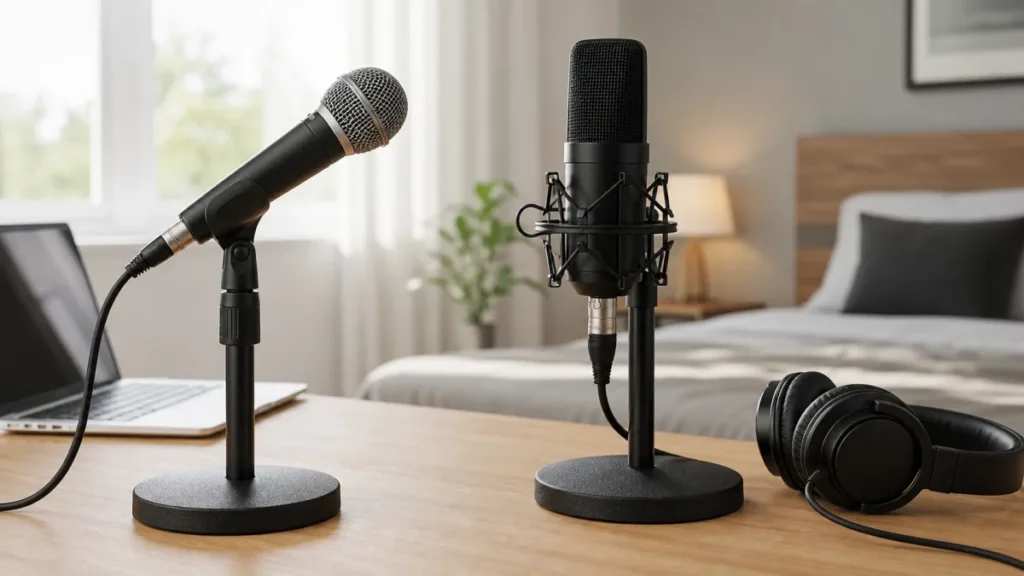
Quick Answer
For quiet bedroom vocals, a condenser mic can capture soft vocal detail more easily, but it can also reveal room reflections, fan noise and street noise. A dynamic mic can be easier to control in an untreated room, but quiet singers may need closer placement, stronger input gain and better monitoring discipline.
MusicalCritic may earn a commission from qualifying links. Illustrative recording setup images do not show exact product testing unless a page explicitly says otherwise.
The safer first choice is not simply “condenser” or “dynamic.” It depends on three checks: how quiet the room is, how close the singer can work, and whether the interface or USB mic can provide enough clean level without clipping or hiss.
Evidence boundary: this comparison uses official microphone specifications as examples and practical recording workflow analysis. It does not claim MusicalCritic performed hands-on bedroom noise tests, measured gain comparisons, current pricing, stock checks, retailer ranking or brand authorization.
Decision Table
| Choice | Better for | Watch out for | Beginner setup risk |
|---|---|---|---|
| Condenser mic | Soft singers in a controlled room who want more vocal detail | More room tone, fan noise, plosives and keyboard noise can become obvious | Requires room discipline and, for XLR condensers, phantom power |
| Dynamic mic | Untreated rooms, louder room noise, close vocal delivery and simple control | Quiet vocals can need more gain and closer technique | Can sound dull or too quiet if the singer backs away |
| USB condenser | Beginners who want a direct computer setup | Still hears the room; limited upgrade path versus XLR | Simple wiring, but room problems remain |
| XLR dynamic | Users who want a long-term interface-based path | Needs an interface and gain staging | More pieces to set up, but often more flexible |
Choose A Condenser If
Choose a condenser first if your room is already quiet, you can record away from loud fans or hard walls, and you want the mic to capture softer vocal details without singing right on top of the grille.
An XLR condenser also makes sense if you already own an interface with phantom power and closed-back headphones. Without those pieces, the microphone purchase is only part of the setup.
Choose A Dynamic If
Choose a dynamic mic first if the room is untreated, you hear computer fans or traffic in test recordings, or you are willing to sing closer to the mic for a more direct sound.
A dynamic mic is not a magic room treatment tool. It can make close vocal technique easier, but it does not erase bad placement, clipping, plosives or headphone bleed.
Quiet-Vocal Setup Checks Before Buying
- Record 20 seconds of room silence before changing microphones.
- Do a close vocal test at the distance you can actually maintain.
- Check whether loud words clip after you raise gain for quiet lines.
- Use closed-back headphones so speaker playback does not confuse the recording.
Mistakes To Avoid
Do not buy a condenser because “quiet voices need sensitive mics” without checking the room. Sensitivity can help capture detail, but it can also capture everything else.
Do not buy a dynamic mic because “dynamic mics reject room noise” as an absolute rule. Placement, pickup pattern, room noise and vocal distance all matter.
Do not compare microphone types using live price alone. The real cost includes stand, pop filter, cable or USB path, interface, headphones and time spent learning gain staging.
Best For / Not For
Condenser path best for: quiet singers in calmer rooms, detail-focused vocal demos, users ready to control plosives and reflections.
Condenser path not for: noisy bedrooms, users without phantom power for XLR models, anyone expecting the mic to fix an untreated room.
Dynamic path best for: untreated rooms, close vocal technique, users who want a more forgiving first setup.
Dynamic path not for: singers who cannot work close to the mic, users with weak input gain, anyone expecting instant studio polish.
Next Reads
- Best Microphones for Bedroom Vocals Under 150
- Best Dynamic Microphones for Untreated Bedrooms
- How to Set Input Gain for Home Vocal Recording
- Home Vocal Recording hub
FAQ
Is a condenser mic better for quiet vocals?
Sometimes. A condenser can capture soft detail well, but it is only the better choice if the room is quiet enough and the setup includes proper power, monitoring and pop control.
Does a dynamic mic need more gain?
Often it needs more gain than a condenser in the same situation, especially with quiet singers. The exact need depends on the mic, interface and how close the singer works.
Which mic is safer in an untreated bedroom?
A dynamic mic is often the safer first path for noisy untreated rooms. A condenser can still work if the room is quiet and the singer controls placement.
How We Test
Editorial workflow comparison using official microphone specifications as examples. MusicalCritic does not claim hands-on bedroom noise testing, measured gain comparisons, current pricing, stock status, retailer ranking or brand authorization.
Review Basis
Shure SM58 and Audio-Technica AT2020 official sources checked 2026-07-20; source evidence is logged in content-source-verification-2026-07-20-0000-0800-batch.md.