
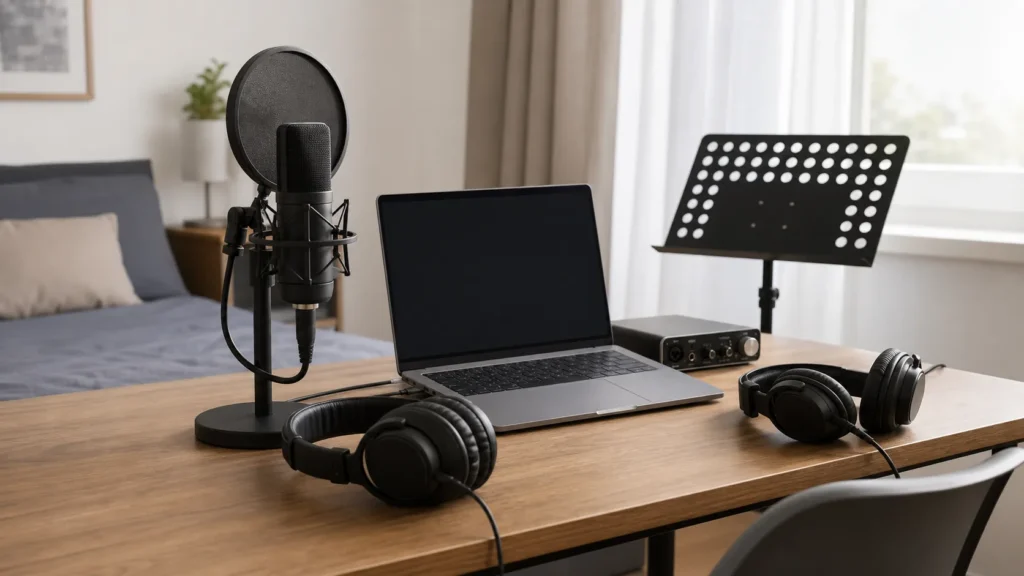
Harmony recording gets easier when each part has a clear job. Beginners should plan the note shape, keep the microphone setup repeatable, record short sections and check whether the harmony supports the lead vocal without making the lyric harder to follow.
MusicalCritic may earn a commission from qualifying links. Illustrative home recording setup; no exact product model or hands-on test is pictured.
Quick Answer
To record harmonies at home, choose one section, decide whether the harmony sits above or below the lead, record with the same mic distance and gain, sing against the lead at a comfortable headphone level and label every take by section and harmony direction.
Who This Is For
This is for beginner singers, producers and songwriters who want simple chorus harmonies, hook support or a second vocal line. It is not meant for advanced vocal arranging or formal music theory. The goal is a cleaner home workflow and a more confident decision about which parts to keep.
Plan One Harmony At A Time
Start with the chorus or the line that matters most. Hum a simple part above or below the lead before recording. If the part makes you lose the main melody, simplify it. A harmony should help the listener feel the hook, not force them to decode two competing lead vocals.
Keep The Setup Consistent
Use the same mic position, pop filter distance and room spot as the lead vocal unless you intentionally want contrast. Consistent setup helps the harmony blend. If you move closer for one take and farther away for another, the tone may change more than the notes do.
Harmony Checklist
| Check | Why it matters | Beginner move |
|---|---|---|
| Range | A strained part sounds distracting | Move the part lower or record a simpler line. |
| Words | Different endings jump out | Match consonants with the lead vocal. |
| Tone | Uneven tone weakens the blend | Repeat the same mic distance. |
| Level | Too loud covers the lead | Start the harmony lower than the main vocal. |
Common Mistakes
Do not record every possible harmony before choosing the best lead take. Do not keep a harmony just because it was hard to sing. Do not leave parts unlabeled. Do not sing so loudly that the harmony changes the emotional focus of the section. Do not use a busy part where a simple double would work better.
What To Read Next
For support layers, read how to record backing vocals at home. For doubles, read how to record vocal doubles. For repeatable takes, read how to keep vocal takes consistent.
FAQ
Should harmonies be perfectly tuned?
They should support the lead clearly, but a natural performance can still work if the note choice and timing feel intentional.
Should I record harmonies before the lead?
No. Choose or at least stabilize the lead vocal first so the harmony has something clear to support.
How many harmony takes should I keep?
Keep the few that improve the song. Extra layers are not automatically better.