
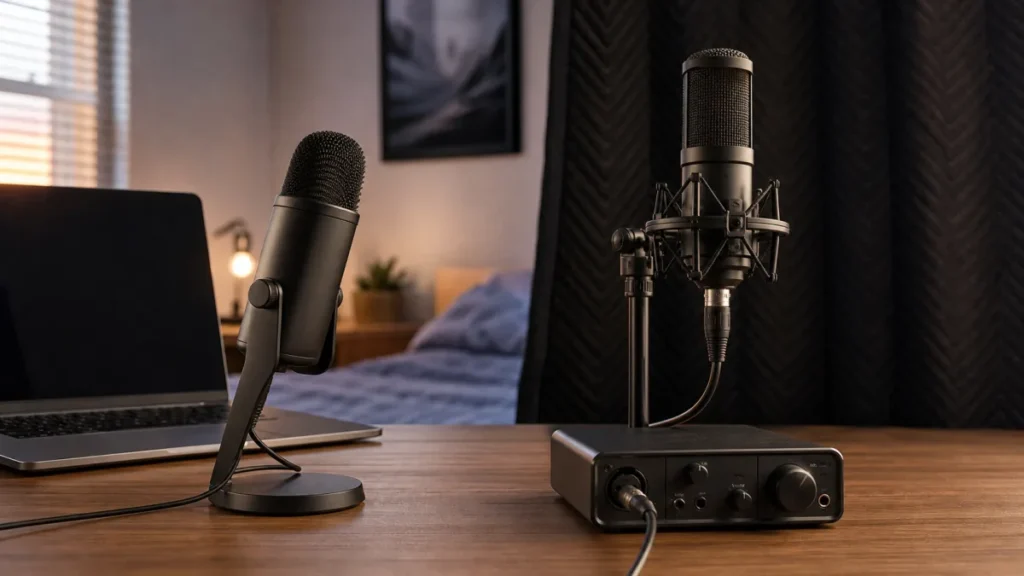
Bedroom Vocal Setup Comparison
Answer first: A USB microphone is usually the simpler first choice for a bedroom vocalist who wants to record one voice into one computer with the fewest parts. An XLR microphone plus audio interface is better when you want upgrade flexibility, stronger monitoring options, future two-source recording or more control over the signal chain.
MusicalCritic may earn a commission from qualifying links. This comparison uses source-bounded setup analysis and does not claim direct product testing, live pricing, stock tracking or a universal winner.
Who This Helps
This page is for beginner vocalists recording in bedrooms, apartments and small home-studio corners. It is not for pro studio engineers or people building multi-mic drum and band setups.
USB Mic Path
The USB path keeps the setup small. The microphone handles the audio conversion and connects directly to the computer, so there is no separate interface to choose. That is useful when the real goal is learning mic distance, room control and recording levels rather than building a studio rack.
The tradeoff is flexibility. A USB mic is usually centered on one microphone and one workflow. If you later want to record guitar and vocal together, use a different XLR mic, or compare interface preamps, you may outgrow the simple path.
XLR Interface Path
The XLR interface path takes more planning but gives a clearer upgrade route. You choose the interface, microphone, cable, stand, headphones and monitoring workflow. For bedroom vocals, the interface should have enough clean gain, a useful headphone output and direct monitoring that does not confuse a beginner.
The risk is overbuying. A beginner who only records one vocal at a desk may spend too much before fixing the room, stand and placement problems that matter more on day one.
Decision Notes
- Choose USB if you want a compact first setup and do not need to record multiple sources.
- Choose XLR plus interface if you expect to expand, record instruments, swap microphones or keep the interface as the center of a growing setup.
- Do not treat XLR as automatically better. Room control, mic distance and monitoring still matter.
Buying Checklist
- One voice only: USB is usually enough.
- Voice plus guitar at the same time: choose an interface with enough inputs.
- Noisy bedroom: prioritize close placement and monitoring.
- Upgrade path matters: choose XLR or dual USB/XLR.
- Budget includes accessories: stand, pop protection and headphones still matter.
Read Next
- Home Vocal Recording for Beginners
- Dynamic Mic vs USB Condenser for Apartment Vocals
- Do USB Microphones Need an Audio Interface?
FAQ
Is XLR automatically better than USB?
No. XLR gives flexibility; it does not fix a bad room or poor mic technique.
Can a USB mic sound good for vocals?
Yes, if placement, gain and room noise are handled well.
Should beginners buy both?
Only if the microphone has a real dual USB/XLR workflow and the extra cost fits the plan.