
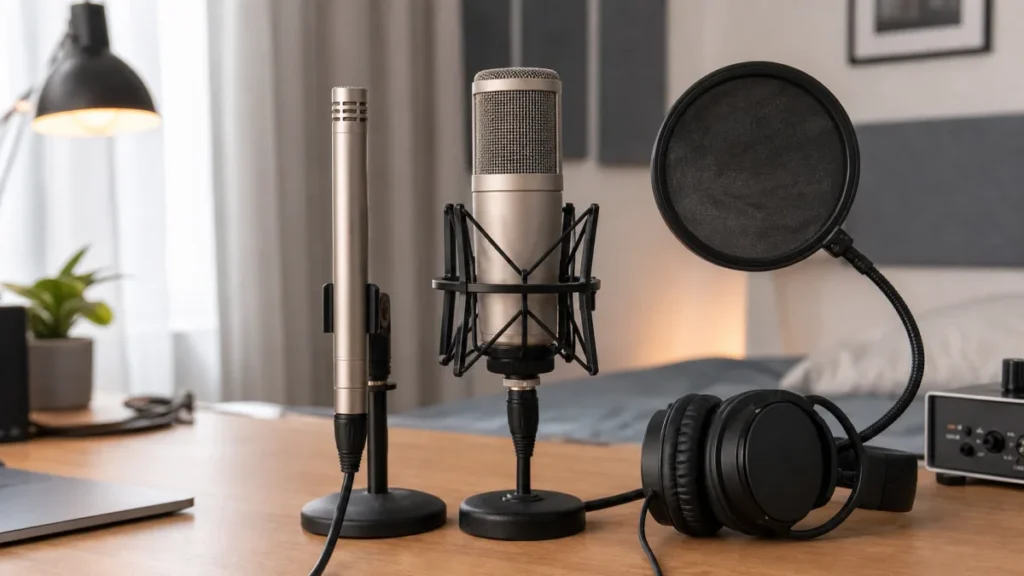
Most beginners recording vocals at home should start by looking at large-diaphragm condenser mics, not small-diaphragm condensers. A large-diaphragm condenser is usually easier to position for a vocal-focused setup and is the more common choice for singer-songwriter, demo and voice recording. A small-diaphragm condenser can be useful for instruments and detailed stereo work, but it is rarely the simplest first vocal mic for an untreated room.
MusicalCritic may earn a commission from qualifying links. This page uses source-bounded editorial guidance; it does not track real-time offers, availability or seller review scores.
Quick Verdict
- Choose a large-diaphragm condenser if your main job is solo vocals, voiceover, podcast-style vocals or singer-songwriter demos.
- Consider a small-diaphragm condenser if you also record acoustic guitar, percussion, room detail or stereo instrument pairs.
- Do not ignore the room: either condenser type can capture reflections, fans, traffic and mouth noise if the setup is too exposed.
What The Size Difference Means For Beginners
The capsule size does not automatically tell you whether a microphone is better. It affects design choices, pickup behavior, tone and typical use cases. For a beginner vocal setup, the practical question is simpler: which mic type is easier to place, easier to understand and less likely to send you into avoidable setup problems?
Why Large-Diaphragm Condensers Are Common For Vocals
Large-diaphragm condensers are popular for vocals because they are designed around close vocal use, clear presence and a familiar side-address working style. A singer can place a pop filter in front, sing into the side of the mic and keep a consistent distance. That workflow is easier for many beginners than aiming a pencil-style mic precisely at the mouth.
Where Small-Diaphragm Condensers Make More Sense
Small-diaphragm condensers are often useful when detail, fast transients and placement accuracy matter. They can be excellent on acoustic instruments in the right room. For a beginner vocal page, the caution is that they can feel less forgiving: the singer may need more careful aiming, stand placement and room control to get a natural result.
Decision Table
| Situation | Better first direction | Why |
|---|---|---|
| Solo vocals at a desk | Large-diaphragm condenser | More familiar close-vocal workflow. |
| Acoustic guitar detail | Small-diaphragm condenser | Often useful for instrument placement. |
| Untreated bedroom | Neither is automatic | Room reflections and noise still matter. |
| First vocal mic only | Large-diaphragm condenser | Simpler vocal-first decision path. |
Buying Checklist
- Decide whether vocals are the main job or one of several instrument jobs.
- Check whether your interface provides phantom power for condenser microphones.
- Budget for a stand, pop filter, XLR cable and closed-back headphones.
- Think about room noise before choosing a sensitive condenser mic.
- Record a short setup test before judging the mic itself.
Read Next
- Home Vocal Recording for Beginners
- Should Beginners Buy A Condenser Mic For Vocals?
- Dynamic Mic vs USB Condenser for Apartment Vocals
FAQ
Is a small-diaphragm condenser bad for vocals?
No. It can work, but it is not usually the easiest first choice for beginner home vocals.
Does a large-diaphragm condenser make vocals professional?
No. Mic placement, room control, performance level and gain staging still matter.
Should beginners buy a condenser at all?
Only if they understand the room tradeoff. A condenser can sound clear, but it can also reveal noise and reflections.