
Decision Scorecard
| Decision Point | Best Fit | What To Check |
|---|---|---|
| Primary use case | Choose around the job you do most often. | Vocals, instruments, practice, monitoring, recording, or live use. |
| Setup complexity | Choose the simpler setup when performance is close. | Cables, software, stands, power, and compatibility. |
| Upgrade path | Choose the option that will stay useful longer. | Whether it still works when your setup grows. |
| Value | Choose the lower total cost, not only lower sticker price. | Accessories and replacement risk matter. |
Pros & Cons
Pros
- Frames the decision around use cases.
- Clarifies who should buy each option.
- Surfaces tradeoffs that spec tables often hide.
Cons
- There may not be one universal fit.
- A third alternative may be better if neither option matches your workflow.
Who It Is For
This comparison is for readers choosing between two close products and needing a clear decision path before buying.
Who Should Avoid It
Avoid forcing this decision if neither product matches your room, instrument, skill level, compatibility needs, or budget.
Alternatives
- Check a category buying guide for a broader shortlist.
- Read individual reviews if one option seems stronger.
- Look at accessories if setup cost is driving the decision.
Final Verdict
Pick the option that solves your main job with the least friction. If neither does, step back to the category guide before buying.
FAQ
How do I choose between two similar products?
Start with your main use case, then compare setup needs, reliability, and total cost.
Should I buy the more expensive option?
Only when the extra cost solves a real problem you will notice in use.
Bedroom Vocal Room Control
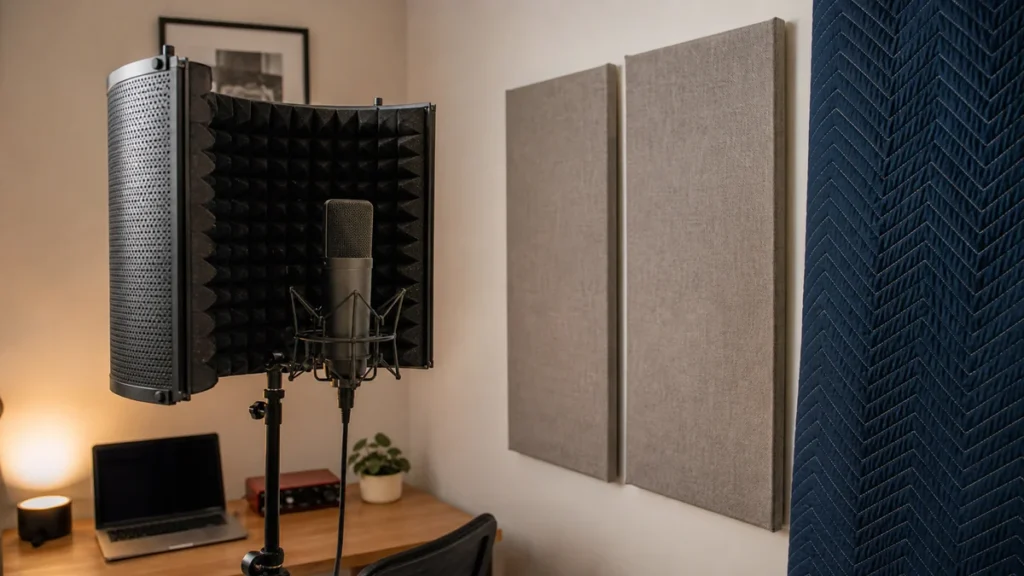
Answer first: A reflection filter can help control some sound around the microphone, but it is not a replacement for acoustic treatment in the room. Acoustic treatment changes the space around the singer; a reflection filter works near the mic. Neither option blocks outside noise from a bedroom.
MusicalCritic may earn a commission from qualifying links. This comparison uses source-backed setup guidance and editorial room-treatment analysis, not lab isolation measurements or real-time offer tracking.
This comparison uses official product and FAQ source boundaries plus editorial setup guidance. It does not claim measured isolation, measured absorption or lab-tested vocal improvement.
What Each One Tries to Solve
| Need | Reflection filter | Acoustic treatment |
|---|---|---|
| Small desk vocal setup | Useful when space is limited. | Better when you can treat wider room surfaces. |
| Room reflections | Can help near the mic, but only locally. | Addresses more of the room when placed well. |
| Outside noise | Does not soundproof. | Does not soundproof unless isolation construction is involved. |
| Beginner setup speed | Faster to add to one mic stand. | Requires more planning and placement. |
| Long-term room improvement | Limited to the recording position. | Usually the more scalable path. |
Choose a Reflection Filter If
- You record at one desk or stand position and cannot change the room much.
- You need a compact first experiment around the microphone.
- Your expectations are realistic: less local reflection help, not a full room fix.
- You can still control mouth distance, gain and background noise.
Choose Acoustic Treatment If
- You can improve the wall area around and behind the singer.
- Your recordings sound boxy, hollow or splashy because of the room.
- You want improvements that help more than one microphone position.
- You understand that treatment and soundproofing are different jobs.
Beginner Upgrade Path
- Record a dry test in the current room.
- Move the mic away from corners and hard nearby walls.
- Try soft furnishings or movable treatment near the singer.
- Add a reflection filter only if your mic position needs local control.
- Compare short clips at the same gain and distance.
Read Next
- Home Vocal Recording for Beginners
- Best Reflection Filters for Bedroom Vocals
- Is a Reflection Filter Worth It for Bedroom Vocals?
FAQ
Does a reflection filter soundproof a room?
No. It works around the microphone position and does not stop neighbors, traffic or computer noise.
Is acoustic treatment always better?
It is usually more scalable, but it may not be practical for renters or very small rooms.
Can you use both?
Yes, but fix obvious placement and room issues first so the filter is not being asked to solve the wrong problem.