
Short Answer
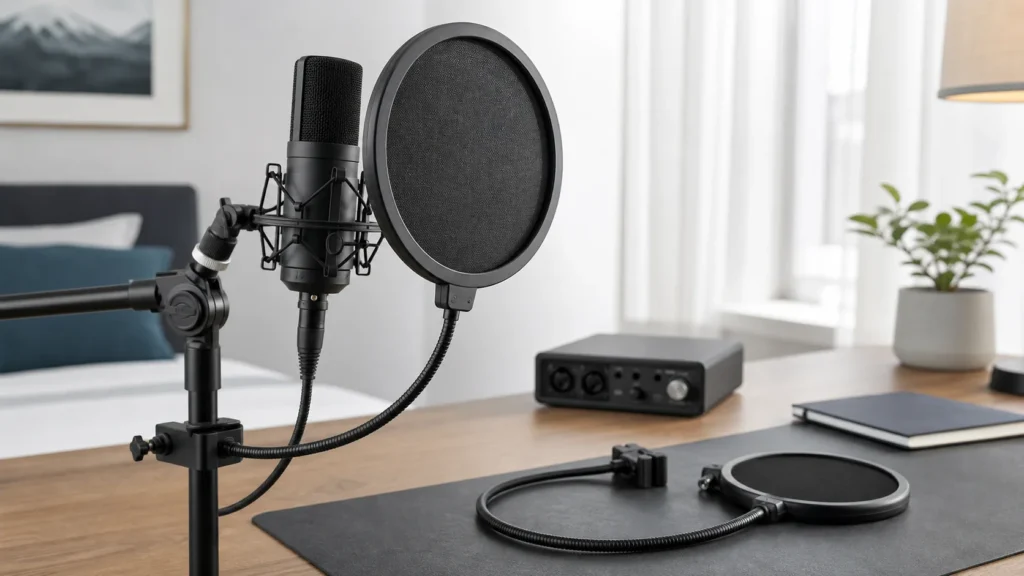
To record vocals with a pop filter at home, place the filter between your mouth and the microphone, leave a small gap between the filter and mic, and keep your mouth distance consistent from take to take.
A pop filter helps with breath blasts and plosive consonants. It does not fix room echo, background noise, clipping, bad headphone monitoring, or an unstable stand.
Evidence boundary: this is an editorial beginner setup guide. It does not claim measured plosive reduction, hands-on accessory testing, current pricing, stock status, rankings, or brand authorization.
What a pop filter actually does
A pop filter gives fast air from words like “pop,” “baby,” and “please” a place to disperse before it reaches the microphone. That matters most when the singer is close to the mic, which is common in bedrooms and untreated rooms.
It is not a room-treatment product. If the vocal sounds boxy or echoey, start with Why Do Home Vocals Sound Boxy? and the Home Vocal Recording hub before buying more accessories.
Basic setup
- Mount the microphone on a stable stand or boom arm.
- Clamp the pop filter to the stand, not to a weak surface that shifts during takes.
- Put the filter between the singer and microphone.
- Leave a small gap between filter and mic so air can disperse.
- Mark the singer position so distance stays repeatable.
- Record a short plosive test before recording the full take.
Pop filter distance mistakes
| Mistake | Why it hurts the take | First fix |
|---|---|---|
| Filter touching the mic | Air has little room to disperse | Move the filter slightly away from the microphone |
| Singer too far back | Gain rises and room sound becomes more obvious | Move the singer closer while keeping plosives controlled |
| Filter sagging during takes | Distance and angle change every pass | Re-clamp the filter or use a steadier stand position |
| Buying a filter before finding the real problem | Room echo, clipping, or bleed may remain unchanged | Check plosives, gain, room sound, and monitoring separately |
Pop filter vs foam windscreen
For most indoor stand-mounted vocal takes, a pop filter is the first choice for plosives. Foam can be useful for some close handheld or covered-mic workflows, but it can be the wrong fix if the real issue is hard consonants hitting the mic.
For the accessory choice, read Pop Filter vs Windscreen for Home Vocal Recording. For buying factors, read Best Pop Filters for Home Vocal Recording.
Before you record the real take
- Say the loudest plosive line into the mic.
- Check that the filter does not block your lyric sheet or screen.
- Make sure the stand does not dip under the filter weight.
- Set input gain for the loudest sung line, not quiet speech.
- Listen for plosives, room echo, and headphone bleed as separate problems.
FAQ
Does a pop filter make vocals sound better?
It can make close vocals cleaner by reducing plosive blasts. It does not make the room quieter or replace good mic placement.
How far should a pop filter be from the microphone?
Leave enough space for air to disperse, then keep the singer’s mouth distance repeatable. The exact distance depends on the stand, mic, singer volume, and plosive strength.
Do dynamic microphones need pop filters?
Sometimes. Close dynamic-mic vocals can still have plosives. Read Do You Need a Pop Filter With a Dynamic Microphone?.
Should I buy a pop filter before a better microphone?
If your current vocal has plosive blasts, a practical pop filter can be a cheaper first fix. If the vocal is noisy or echoey, solve room and placement problems first.
Bottom line
A pop filter is useful when it makes close vocal distance more repeatable and less plosive-heavy. Use it with a stable stand, sensible gain, closed-back monitoring, and a quiet room position.
How We Test
Editorial beginner setup guide based on MusicalCritic home-vocal workflow analysis checked 2026-07-19. This page does not claim hands-on accessory testing, measured plosive reduction, current pricing, stock status, rankings, or brand authorization.
Review Basis
MusicalCritic beginner home-vocal workflow analysis checked 2026-07-19; no live retailer data or measured accessory tests used.