
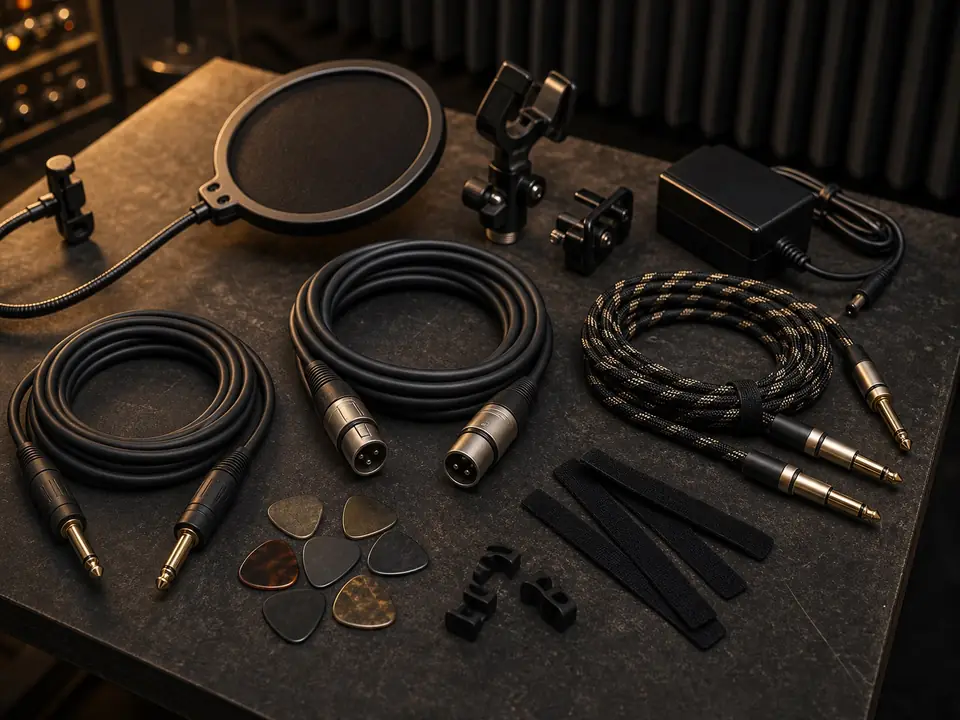
Quick Verdict
Choose a straight XLR cable first if your microphone and interface have open clearance. It is the simplest, most flexible beginner option because it works with more mic stands, interfaces and room layouts.
Choose a right-angle XLR connector only when you know the cable needs to turn immediately. That can help near a wall, desk edge, interface jack, boom arm or tight floor-stand setup. The risk is that the right-angle plug may point the cable the wrong way if your layout changes.
Evidence boundary: this is a physical setup comparison, not a lab test. MusicalCritic is not claiming measured cable noise, shielding performance, current prices, stock status, brand ranking or retailer availability.
The real decision is clearance
A straight XLR connector comes out from the jack in a direct line. That is usually fine when there is space behind the microphone or interface. A right-angle connector turns the cable immediately, which can reduce cable strain in a tight spot.
The connector shape does not make a beginner vocal sound better by itself. The point is practical: avoid pulling on the mic, bending the cable sharply, blocking a desk, or forcing the interface to sit in an awkward position.
Straight vs right-angle XLR
| Connector | Best fit | Why choose it | Main caution |
|---|---|---|---|
| Straight XLR | Most beginner bedroom setups | More flexible if you move the mic, stand or interface later | Needs enough rear clearance so the cable does not bend sharply |
| Right-angle XLR at the microphone | Mic close to a wall, desk edge or tight boom-arm path | Can point the cable away from the singer or wall immediately | May point in the wrong direction depending on mic clip and stand angle |
| Right-angle XLR at the interface | Interface pushed near a wall or crowded desk | Can reduce cable bend behind or beside the interface | May block nearby controls or adjacent inputs on a small interface |
When straight XLR is the safer first buy
Pick straight XLR when you are still experimenting with the room. Beginners often move the mic stand, rotate the interface, change desks or switch from a desk arm to a floor stand. A straight connector is less likely to become awkward after those changes.
It is also safer when you are not sure which side the cable should exit from. A right-angle connector is useful only when the direction is useful.
When right-angle XLR makes sense
Right-angle XLR makes sense when you have already seen the clearance problem. For example, the microphone is near a wall, the cable pushes into the desk, or the audio interface sits close to the back of a shelf.
It can also help with a boom arm when a straight plug sticks out in a way that catches the cable or pulls the microphone angle down. Before buying, imagine the exact direction the plug will point after the mic is clipped in place.
Do this before buying
- Put the mic, stand, interface and chair where you actually record.
- Check whether a straight plug would hit a wall, desk or stand joint.
- Check whether a right-angle plug would point toward the clean cable path.
- Look for nearby interface knobs or inputs that a right-angle plug could block.
- Choose cable length separately from connector shape.
For length, use 6 ft vs 10 ft vs 15 ft XLR Cables for Bedroom Vocals. For the broader accessory path, use Best XLR Cables for Home Studios.
Where this fits in a beginner vocal setup
If you are still deciding whether to use XLR at all, start with Dynamic Microphone vs USB Microphone for Bedroom Vocals. If the stand is still undecided, read Boom Arm vs Floor Mic Stand for Bedroom Vocals.
For the complete beginner cable list, read What Cables Do You Need for a Home Studio? or start from the Home Vocal Recording hub.
FAQ
Is right-angle XLR better for bedroom vocals?
Only if it solves a real clearance or cable-routing problem. Straight XLR is usually the safer first buy when your layout is still changing.
Can a right-angle XLR plug block interface controls?
Yes. On small interfaces, a right-angle connector can point toward a knob, button or neighboring input, so check the jack layout before buying.
Does right-angle XLR sound different?
This page does not make measured performance claims. For beginner bedroom vocals, the main decision is physical fit and cable strain, not tone.
Should the right-angle connector be at the mic or interface end?
Put it where the clearance problem exists. Some users need the turn at the mic, others near the interface. Do not assume both ends need it.
Should I choose connector shape before cable length?
No. Decide both from the actual room path. Length solves reach; connector shape solves clearance and direction.
How We Test
Editorial setup-planning comparison. This page does not claim hands-on cable testing, measured shielding, measured noise, current pricing, stock status, brand ranking or retailer availability.
Review Basis
MusicalCritic beginner bedroom-vocal setup analysis checked 2026-07-18. No model-specific manufacturer claims are used.