
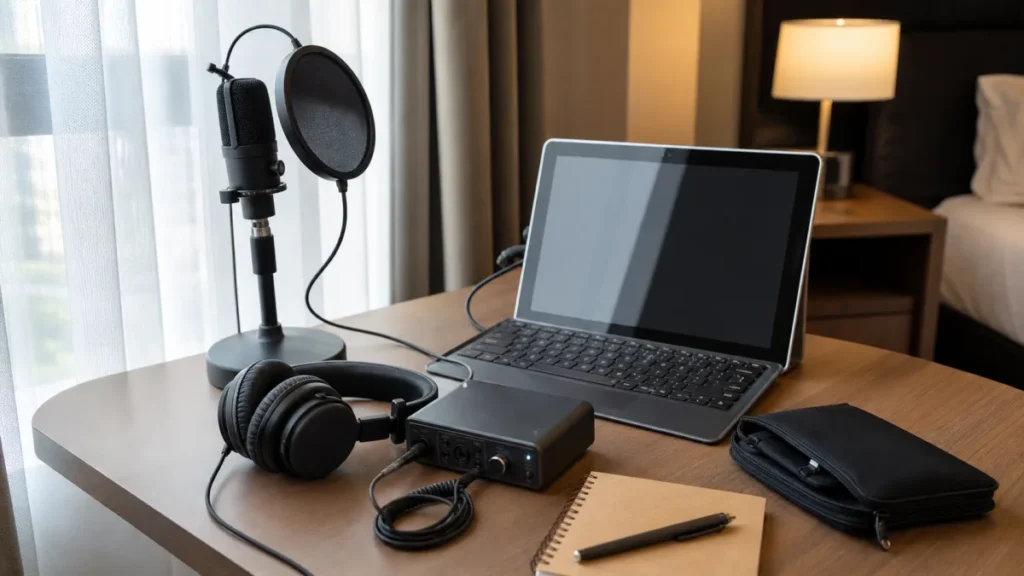
A portable vocal recording setup can be enough for beginner demos, songwriting and travel practice, but it is not a shortcut around room noise, mic placement or monitoring discipline. The best portable setup is the one you can assemble consistently without creating new noise, latency or power problems.
MusicalCritic may earn a commission from qualifying links. This guide uses editorial setup analysis and source-bounded beginner guidance, not lab testing, exact rig testing, retailer-feed monitoring or paid placement.
Quick Verdict
- Good for: demo vocals, lyric ideas, songwriting sessions, travel practice and simple content voice tracks.
- Not ideal for: polished release vocals, noisy hotel rooms, untreated reflective spaces or sessions that need multiple performers.
- Biggest risk: assuming portable gear solves the room. The room and headphone monitoring still shape the recording.
What Counts As A Portable Vocal Setup?
For this review, a portable setup means a compact recording chain a beginner can pack and rebuild: a USB mic or small interface and XLR mic, closed-back headphones, a short stand or compact boom, cable, laptop or tablet and a simple pop-filter solution. It does not mean a fully treated studio in a bag.
Where Portable Setups Work Well
Portable setups work best when the goal is capturing ideas quickly. A songwriter can record guide vocals, test melodies and share demos without waiting for a studio day. For beginners, the value is convenience and repeatability, not guaranteed studio quality.
Where They Fall Short
The limits appear when the room is loud or reflective, when the mic is placed too close to a laptop fan, or when monitoring latency distracts the singer. A compact setup also gives less physical stability than a permanent desk or stand arrangement.
Scorecard For Beginners
| Category | Portable setup verdict | Beginner note |
|---|---|---|
| Convenience | Strong | Easy to pack and rebuild if the chain is simple. |
| Sound isolation | Weak | Portability does not block room noise. |
| Monitoring | Mixed | Direct monitoring helps; software monitoring needs testing. |
| Upgrade path | Depends | Small interfaces usually upgrade better than fixed USB-only chains. |
| Consistency | Mixed | Marking mic distance and setup position helps repeat results. |
Portable Setup Checklist
- Pack closed-back headphones, not open-back headphones or speakers.
- Use a stand or mount that keeps the mic off the laptop and desk surface.
- Test the loudest vocal line before saving a session template.
- Keep the mic away from laptop fans, windows and hard bare walls.
- Record a 20-second room-noise test before the real take.
Read Next
- Best Budget Vocal Recording Kits Under $300
- How to Record Vocals in a Small Bedroom
- What Is Zero-Latency Monitoring for Vocal Recording?
- Home Vocal Recording for Beginners
FAQ
Can beginners record good vocals with a portable setup?
Yes for demos and practice, if the room is quiet enough and the monitoring path is comfortable.
Is a portable setup better with USB or XLR?
USB is simpler. XLR with a compact interface is more flexible if you expect to upgrade microphones later.
Does a portable vocal shield make the setup studio-quality?
No. Shields can change nearby reflections, but they do not soundproof the room or remove background noise.