
Top Picks Comparison
| Pick Type | Best For | What To Check |
|---|---|---|
| Best Overall | Most musicians who want the safest first choice. | Balance of sound, usability, build, and price. |
| Best Budget | Beginners who need dependable gear without overspending. | Core performance before extra features. |
| Best Upgrade | Players and creators ready to improve a specific weak point. | Clear improvement over entry-level options. |
Pros & Cons
Pros
- Keeps the buying decision tied to real use cases.
- Highlights accessories and setup needs before checkout.
- Compares practical tradeoffs instead of only specifications.
Cons
- Final choice still depends on room, instrument, skill level, and budget.
- Availability and pricing can change by retailer.
Who It Is For
This guide is for musicians, producers, students, and home studio creators who want a clear shortlist before comparing product-level reviews.
Who Should Avoid It
Avoid using any guide as a blind recommendation if you have unusual compatibility needs, strict stage requirements, or a very specific studio workflow.
Alternatives
- Read individual reviews when one product looks like the strongest fit.
- Use comparisons when two models solve the same problem in different ways.
- Check the related category hub for setup essentials and beginner advice.
Final Verdict
The best buy is the product that fits the job, works with the rest of your setup, and leaves the fewest costly surprises after purchase.
FAQ
How should beginners use this guide?
Start with the recommended use case, then check whether the required accessories and setup match your budget.
Should I buy the cheapest option first?
Only if it still solves the core job reliably. Cheap gear becomes expensive when it needs to be replaced quickly.
USB Dynamic Mic Buying Guide
Quick verdict: The best USB dynamic microphone for bedroom vocals is the one that lets you record close, monitor clearly and keep setup decisions simple. Prioritize USB workflow, headphone monitoring, gain control and a stable mounting plan before chasing a product list.
MusicalCritic may earn a commission from qualifying links. This guide uses official product information and editorial buyer criteria. It is not a direct product test, active pricing feed, stock report or retailer-score roundup.
Why USB Dynamic Works for Bedrooms
USB dynamic microphones combine two beginner-friendly traits: they connect directly to a computer and they reward close vocal placement. That makes them useful in bedrooms where room noise and reflections are harder to control.
They are not magic noise removers. The mic still needs to be close, the singer still needs pop protection, and the room still needs basic quieting. But the format can reduce the number of parts a beginner has to troubleshoot.
Source-Bounded Shortlist
Shure MV7+
The Shure MV7+ is the flexible pick for creators who want USB now and XLR later. Shure’s official product and user-guide materials support the dual-path setup boundary, making it a strong option for beginners who expect to grow beyond one direct-computer workflow.
Best for: vocal creators who want a simple start and an upgrade route.
Not for: buyers who only need the lowest-cost USB mic.
Audio-Technica AT2040USB
The Audio-Technica AT2040USB is a USB dynamic option for creators who want a direct computer microphone without buying an interface first. It belongs in the shortlist for users who care more about a self-contained USB setup than an XLR upgrade path.
Best for: bedroom creators who want USB-first simplicity.
Not for: users who want to build a multi-input recording chain.
PreSonus Revelator Dynamic
The PreSonus Revelator Dynamic is a USB dynamic microphone with a software-centered workflow. It makes sense for users who want presets and routing tools alongside the microphone rather than a traditional interface-first chain.
Best for: creators who value software control and preset workflow.
Not for: users who prefer a minimal hardware path.
Buying Criteria
- USB connection and OS/device compatibility.
- Headphone monitoring and mix control.
- Practical gain range for close vocals.
- Mounting compatibility with a real stand or arm.
- Clear documentation for mute, monitoring and software behavior.
- No unsupported claims about removing room noise.
Source Note
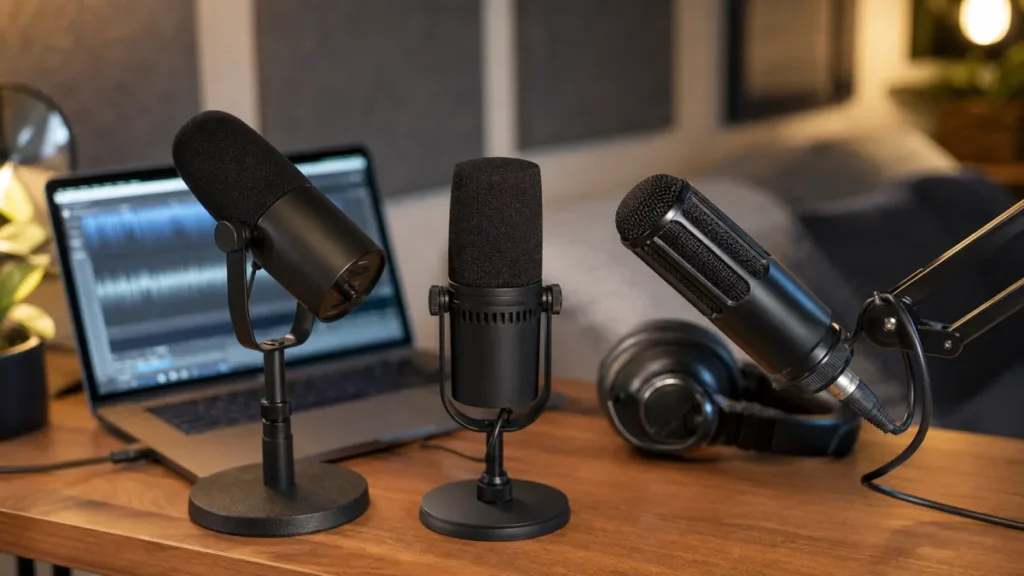
Product-specific details in this guide are bounded to official manufacturer pages and guides for the Shure MV7+, Audio-Technica AT2040USB, PreSonus Revelator Dynamic and Cloud Microphones CL-1 where relevant. The featured image is a generic photographic scene and does not show or claim any exact product model.
Read Next
- Home Vocal Recording for Beginners
- Dynamic Mic vs USB Condenser for Apartment Vocals
- Do USB Microphones Need an Audio Interface?
FAQ
Is USB dynamic better than USB condenser?
It is often more forgiving in a noisy bedroom, but not always better in a quiet room.
Do I need an audio interface?
No, not for USB mode. A dual USB/XLR mic only needs an interface when you use its XLR output.
Should I buy by brand first?
Buy by workflow first: USB-only, USB/XLR, monitoring and mounting needs.