
Quick Verdict
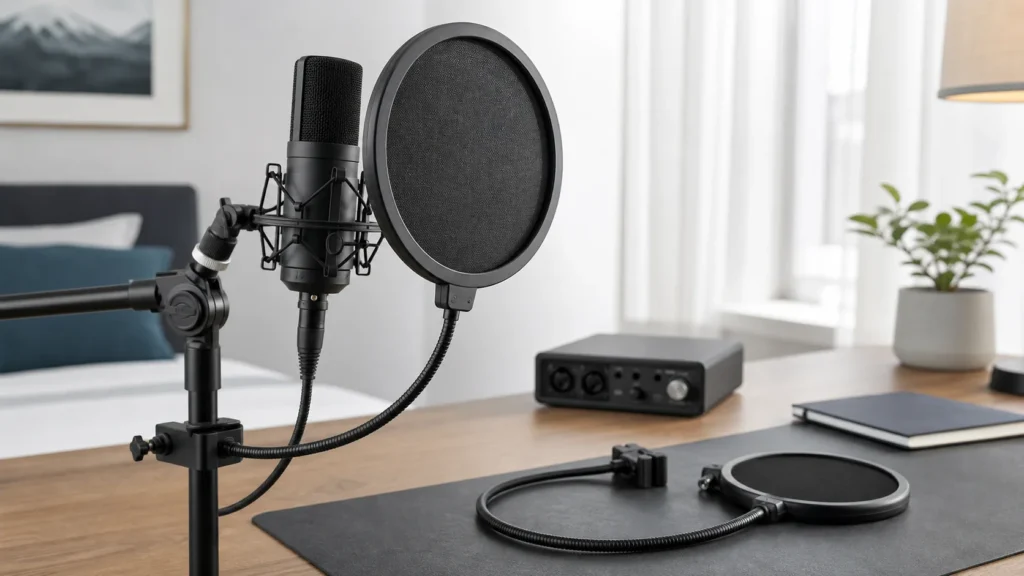
The best pop filter for home vocal recording is the one that fits your stand, stays in position and gives the singer repeatable distance from the microphone. Beginners should prioritize clamp fit, stable gooseneck positioning, screen size, easy cleaning and compatibility with the actual boom arm or floor stand.
Do not buy by looks alone. A pop filter that looks professional but sags, blocks the singer’s view, cannot clamp securely or sits too close to the mic will slow down the recording session.
Evidence boundary: this is a criteria-first guide, not a product lab test or ranked affiliate roundup. It does not claim measured plosive reduction, measured tone, current pricing, stock status, hands-on testing or universal product superiority.
Who This Guide Is For
This guide is for beginner vocalists, songwriters and creators recording in a bedroom, apartment or small home studio. It is most useful if the vocal has sharp P and B bursts, breath hits or inconsistent distance from the mic.
It is not a product lab test. It is a buying checklist for choosing a low-friction pop filter without making unsupported claims about exact plosive reduction or sound quality.
What Matters Most
| Buying factor | Why it matters for home vocals | Beginner mistake |
|---|---|---|
| Clamp fit | The filter must attach securely to the stand or boom arm | Buying a clamp that slips on a round or thick arm |
| Neck stiffness | The screen must stay where it is placed | Choosing a neck that sags into the mic |
| Screen size | The singer needs a practical target area | Buying a tiny screen for inconsistent singers |
| Distance control | The filter should encourage repeatable spacing | Pressing the filter against the mic grille |
| Cleaning | Mouth-facing accessories need basic care | Leaving fabric or mesh dirty between sessions |
| Storage | Small rooms need gear that packs away | Bending the neck until it no longer holds position |
Criteria-First Shortlist Logic
Instead of naming a universal winner, choose by setup:
- Desk boom arm: prioritize clamp security and a neck that does not pull the arm out of position.
- Floor stand: prioritize reach and angle so the singer can stand comfortably.
- Large condenser microphone: make sure the screen can sit in front of the mic without touching the shock mount.
- Dynamic microphone: check whether the singer is close enough that plosive control and distance discipline are both needed.
- Shared room or beginner setup: choose something easy to remove, clean and reposition.
Source-Limited Examples
| Example | What the source supports | What not to claim |
|---|---|---|
| Shure PS-6 | Shure describes it as intended to attenuate breath noise and plosives and includes a clamp for microphone stands and booms. | Do not claim current availability, price or a buy-now recommendation because the source page presents it as unavailable. |
| Stedman Proscreen line | Stedman publishes fit-related dimensions and clamp range, which can support setup-fit discussion. | Do not claim it is the best sounding, most durable or universally compatible without separate evidence. |
This table is not a final ranking. It only shows what can be discussed from the currently verified sources.
Buying Mistakes To Avoid
The first mistake is buying a pop filter that cannot clamp to the actual stand. Check the stand or boom arm shape before buying. A strong filter is still a bad fit if it constantly slips.
The second mistake is putting the screen too close to the microphone grille. The filter should help the singer keep a repeatable position, not become part of the mic body.
The third mistake is buying foam when the main issue is plosives. A foam windscreen can be useful in some close-mic workflows, but an indoor stand-mounted vocal usually starts with a pop filter.
The fourth mistake is ignoring the rest of the chain. If the stand wobbles, the room is echoey or the headphone cue is bleeding, a pop filter alone will not fix the recording.
Setup Checklist
- Clamp the filter to the actual stand or boom arm.
- Position the screen between the singer and microphone without touching the grille.
- Record a phrase with repeated P and B sounds.
- Check whether the singer can still see lyrics or a screen comfortably.
- Listen for plosives, room echo and headphone bleed separately.
- Reposition before buying another accessory.
Who Should Skip Buying One
Skip buying a pop filter if the microphone already includes an effective pop solution and the current problem is not plosives. Skip it if the vocal sounds boxy, echoey or noisy; those problems usually need room position, mic distance, gain control or monitoring changes first.
Related Setup Decisions
If you are not sure whether foam is enough, compare pop filter vs windscreen for home vocal recording. If the filter clamp keeps pulling your setup down, compare boom arm vs floor stand for bedroom vocals.
For the full setup sequence, start from the Home Vocal Recording hub and fix room, stand, monitoring and gain issues separately.
FAQ
What is the best pop filter for home vocals?
The best first choice is a pop filter that clamps securely to your stand, stays in position and lets the singer keep consistent distance from the microphone.
Does a pop filter make vocals sound better?
It can help reduce plosive problems, but this page does not claim measured sound improvement. It is a technique and setup tool, not an automatic vocal upgrade.
Should I buy a pop filter or foam windscreen?
For most indoor stand-mounted vocals, start with a pop filter. Use foam when the microphone and workflow call for close covered use or breath/wind control.
Can I use a pop filter with a boom arm?
Yes, if the clamp fits securely and the boom arm can hold the extra position without sagging or twisting.
Is Shure PS-6 a current recommendation?
Not in this draft. Shure’s page supports what the accessory is designed to do, but the item is presented as unavailable, so it should not be framed as a current buy-now pick.
How We Test
Criteria-first buying guide with source-limited examples. MusicalCritic does not claim hands-on testing, measured plosive reduction, measured tonal change, current price, stock status, retailer ranking or universal product superiority.
Review Basis
Shure PS-6 and Stedman Proscreen source-limited accessory facts checked 2026-07-19, plus MusicalCritic beginner setup analysis.