
Quick Answer
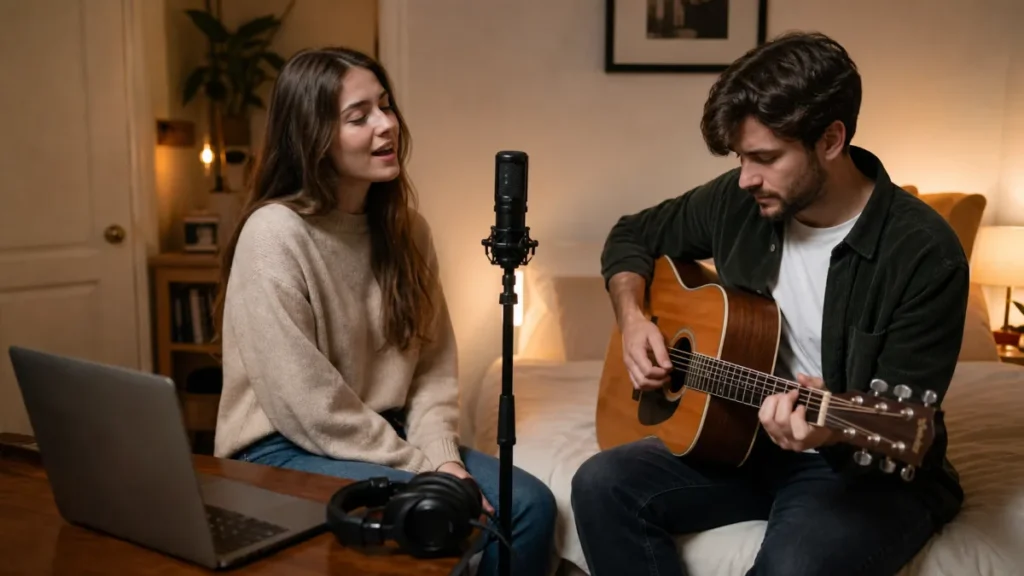
You can record acoustic guitar and vocals with one mic if the goal is a clear songwriter demo and the performer balances the voice and guitar before pressing record. Start with one repeatable mic position, record a short test, then move the singer or guitar before changing gear.
MusicalCritic may earn a commission from qualifying links. Illustrative recording setup images do not show exact product testing unless a page explicitly says otherwise.
Evidence boundary: this is a beginner workflow guide. It does not claim universal mic distance, stereo results, phase measurements, professional release quality or product-specific testing.
Best For / Not For
Best for first demos, song sketches, simple one-input setups and performers who can adjust voice and guitar balance naturally. Not for separate mixing control, stereo guitar, professional release tracking or situations where vocal and guitar must be edited independently.
Starter Workflow
- Choose the quietest position in the room.
- Place the microphone where it hears both vocal and guitar naturally.
- Record 20 seconds of the loudest chorus or phrase.
- Listen for vocal/guitar balance before changing gain.
- Move the performer or guitar angle before buying another mic.
- Use closed-back headphones if recording to a guide track.
Placement Logic
There is no universal distance that works for every singer, guitar, room and microphone. Treat the first placement as a starting point, not a rule. If the guitar overwhelms the vocal, move the guitar slightly away from the microphone or ask the performer to play lighter. If the vocal overwhelms the guitar, angle the guitar more toward the mic or move the singer slightly back.
Do not fix a balance problem by raising input gain first. Gain changes the whole signal. Position changes the relationship between voice, guitar and room.
When One Mic Is Enough
One mic is enough when the purpose is to capture the song, performance feel, lyric phrasing and arrangement idea. It can be faster than building a two-mic setup, and it forces the performer to balance the part at the source.
When To Upgrade
One mic is not enough when you need separate vocal processing, separate guitar EQ, comping, heavy editing or a polished mix. In that case, move toward two inputs or overdub the parts separately.
FAQ
Where should one mic go?
Start where it hears both voice and guitar, then adjust based on a short recording. The right spot depends on the singer, guitar, room and microphone.
Can I overdub instead?
Yes. Overdubbing can give more control if the live one-mic balance is not working.
When should I upgrade to two mics?
Upgrade when you need separate vocal and guitar levels, separate processing or more editing control than a one-mic recording can provide.
How We Test
Beginner workflow guide. MusicalCritic does not claim universal mic distance, stereo results, phase measurements, professional release quality or product-specific testing.
Review Basis
MusicalCritic one-mic singer-songwriter workflow analysis checked 2026-07-20.