
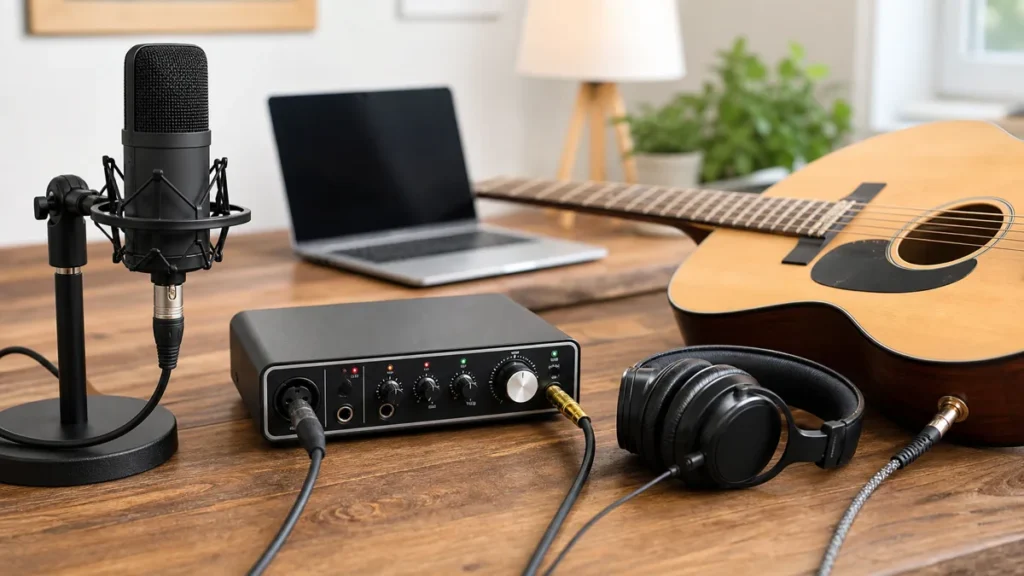
Quick Answer
For singer-songwriter vocal and guitar demos, the safest first audio interface is usually a two-input model with at least one XLR microphone input, a usable instrument input, direct monitoring and a headphone output. One-input interfaces can work for overdubs, but they limit live vocal-and-guitar capture.
MusicalCritic may earn a commission from qualifying links. Illustrative recording setup images do not show exact product testing unless a page explicitly says otherwise.
Evidence boundary: this is a criteria-first guide. It does not claim measured preamp tests, latency benchmarks, driver reliability tests, live stock, retailer ranking or brand authorization.
What To Prioritize
| Need | Why it matters | Safer beginner choice |
|---|---|---|
| Two inputs | Lets you capture vocal mic and guitar/direct source together | 2-input interface if live demo capture matters |
| One XLR mic input | Required for most XLR vocal microphones | At least one XLR input with phantom power if using a condenser |
| Instrument input | Useful for direct electric guitar, bass or acoustic pickup demos | Front-panel Hi-Z instrument input |
| Direct monitoring | Helps avoid distracting headphone delay | Clear hardware knob, button or mixer control |
| Headphone output | Required for vocal tracking without speaker bleed | Easy-to-reach headphone jack and level control |
When One Input Is Enough
A one-input interface can work if you record vocals and guitar separately. This is often fine for arranged demos, layered parts and users who do not need a live performance feel.
It becomes limiting when the song depends on singing and playing at the same time, or when you want a microphone on the vocal and a direct guitar signal together.
When Two Inputs Are Worth It
Two inputs are worth it when demos start from live performance. A common beginner path is one vocal mic plus one instrument input, or one mic on the vocal and one mic on the guitar. This needs routing discipline, but it avoids replacing the interface immediately.
Buying Checks Before Paying
- Confirm the exact number of microphone inputs, not just total inputs.
- Confirm phantom power if using an XLR condenser.
- Confirm direct monitoring controls before assuming latency will be easy.
- Confirm driver and operating-system support on the maker’s site.
- Confirm the return policy in case the headphone level or routing does not fit your setup.
FAQ
Do singer-songwriters need a two-input interface?
Not always. You need two inputs if you want to capture vocal and guitar at the same time. One input can work for overdubs.
Is direct monitoring important?
Yes, for many beginners. It helps the singer hear their live voice without distracting delay.
Should I buy an interface before a microphone?
If you plan to use an XLR microphone, yes, the interface is part of the chain. USB microphones can skip the interface at first but limit the upgrade path.
How We Test
Editorial criteria guide based on beginner singer-songwriter workflow needs. MusicalCritic does not claim measured preamp performance, latency benchmarks, driver reliability tests, live stock, retailer ranking or brand authorization.
Review Basis
MusicalCritic singer-songwriter interface workflow analysis checked 2026-07-20.