
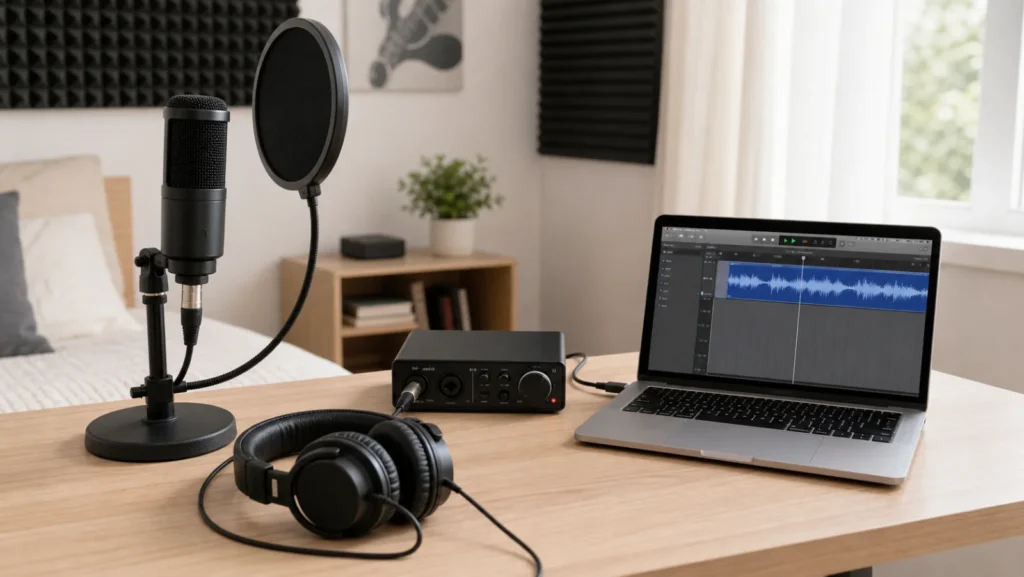
Quick answer: Home vocals usually sound boxy because the microphone is hearing too much small-room reflection, desk bounce, wall buildup, or low-mid resonance around the voice. Before buying new gear, fix mic placement, move away from corners, reduce hard reflections near the singer, and cut only a little low-mid mud while mixing.
What boxy vocals sound like
A boxy vocal often sounds hollow, closed-in, or like it was recorded inside a small closet. It may not be noisy or distorted, but the voice feels trapped instead of clear. Beginners often blame the microphone first, but the room and placement are usually bigger causes.
The most common causes
| Cause | What you hear | First fix |
|---|---|---|
| Mic too close to a wall or corner | Thick, uneven low mids | Move the mic and singer toward the room center |
| Hard desk or bare wall reflections | Hollow or papery tone | Move the mic off the desk and soften nearby surfaces |
| Closet recording with too many clothes around the mic | Dull and closed-in | Use a more open spot with controlled reflection, not a sealed box |
| Singing too far from the mic | More room than voice | Move closer and control plosives with a pop filter |
| Too much low-mid EQ | Muddy and congested | Use a narrow, small EQ cut after recording |
Fix placement before replacing the microphone
Start by moving the mic away from walls, corners, windows, and large hard surfaces. If the mic is on a desk, try a stand or boom arm so the capsule is not sitting directly above a reflective tabletop. Sing into the room rather than directly into a bare wall.
Record the same phrase in three positions: near the current desk, a few feet away from the wall, and in a more open part of the room. If one position sounds clearer, the room was the problem, not the microphone.
Do not over-treat the room
A closet full of clothes can reduce bright reflections, but it can also make the vocal sound small and muffled. For beginner vocals, the goal is not to remove every reflection. The goal is to reduce the closest hard reflections while keeping the voice natural.
- Keep the singer away from corners.
- Put soft material behind or beside the singer if a bare wall is close.
- Use a pop filter so the singer can stay closer without plosives.
- Record a short test before changing gear.
When EQ helps
EQ can help after placement is improved. A small cut in the low-mid area can reduce boxiness, but do not carve the vocal aggressively before fixing the recording position. Heavy EQ on a bad recording often makes the voice thinner without making it more professional.
If the vocal sounds boxy and dull at the same time, try improving placement first. If it only has a small low-mid buildup, a light EQ move may be enough.
When gear actually matters
If you already moved the mic, controlled nearby reflections, and recorded closer to the capsule, then microphone choice can matter. Dynamic microphones are often more forgiving in untreated rooms, while condenser microphones can reveal more room tone. But a better mic will still sound limited if the room placement is poor.
Best next step
Start with mic placement for better vocals, then read how to reduce room noise before buying gear. If the room is still the main problem, compare microphones for untreated rooms. For the full beginner path, use the home vocal recording guide.
FAQ
Does a better microphone fix boxy vocals?
Sometimes, but not first. Placement and room reflections usually matter more than the microphone when a vocal sounds boxy in a bedroom.
Is a closet good for recording vocals?
A closet can reduce bright reflections, but it can also make vocals sound dull and boxed-in. Test it against a more open room position before committing.
Should I use foam behind the microphone?
Foam can help with some reflections, but placement and the singer’s position matter more. Do not expect a small foam shield to fix a poor room by itself.
How We Test
Editorial workflow guidance based on common home-vocal placement and small-room reflection problems; no claim of lab room measurement.
Review Basis
Editorial research and beginner setup guidance; not a product lab test.