
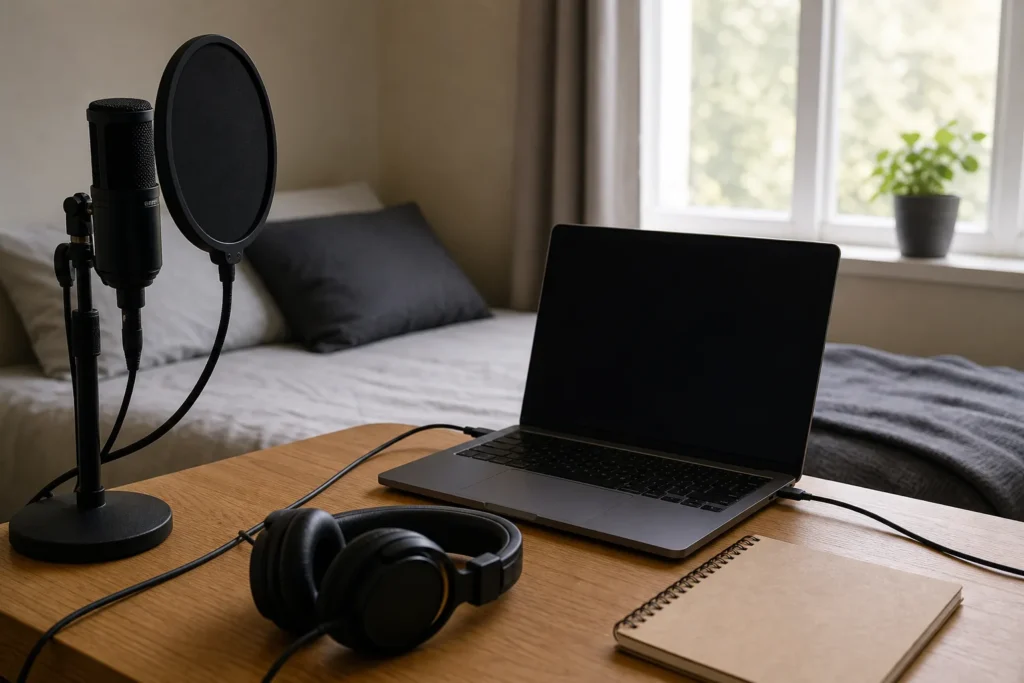
A scratch vocal is a temporary vocal recorded to guide the song while you build the arrangement. Beginners should record one when they need timing, melody or lyric direction, but they should label it clearly and avoid treating it as the final take by accident.
MusicalCritic may earn a commission from qualifying links. Illustrative home recording setup; no exact product model or hands-on test is pictured.
Quick Answer
A scratch vocal is a guide vocal. Record one when you are arranging a song, checking structure, tracking instruments or writing harmonies. Replace it when the song is ready for a cleaner performance, unless the scratch take has a special feel and the recording quality still serves the track.
What A Scratch Vocal Is
A scratch vocal gives the session a map. It tells you where verses, hooks, pauses and emotional changes happen. It does not need to be perfect, but it should be clear enough that you can build other parts around it without guessing.
When Beginners Should Record One
Record a scratch vocal early if the song still feels hard to follow without the voice. It helps guitar, keys, beat programming and backing vocals stay connected to the lyric. It can also reveal whether a chorus starts too late, a verse is too long or a melody needs more space.
How To Record A Useful Scratch Vocal
- Use a simple mic position that does not slow the writing session down.
- Record the full structure if the song is still being shaped.
- Label the take as scratch so it is not confused with the final vocal.
- Write notes for any lyric changes or weak sections.
- Replace or re-record once the arrangement is ready.
Scratch Vocal Vs Final Vocal
| Part | Scratch vocal | Final vocal |
|---|---|---|
| Purpose | Guide the song | Carry the listener experience |
| Performance | Clear enough to follow | Intentional and repeatable |
| Editing | Minimal notes are enough | Needs careful take choice |
| Label | Always marked as scratch | Marked as lead or final candidate |
When To Keep It
Sometimes a scratch vocal has emotion that is hard to repeat. You can keep it if the recording quality, lyric clarity and noise level fit the song. Still compare it against a focused final take. Do not keep a noisy scratch take only because it was first.
Common Mistakes
Do not leave the scratch vocal unlabeled. Do not build harmonies around a melody you plan to change. Do not spend an hour polishing a guide vocal if the song structure is unfinished. Do not assume the scratch take is unusable either; listen with the full arrangement before deciding.
What To Read Next
For quick rough takes, read how to record a quick demo vocal at home. For final take checks, read what to check before re-recording vocals. For labels, read how to label vocal takes.
FAQ
Does a scratch vocal need to sound polished?
No. It needs to be clear enough to guide timing, lyrics and structure.
Can a scratch vocal become the final vocal?
Yes, if the performance works and the recording quality fits the song. Compare it honestly with a dedicated final take.
Should I delete scratch vocals?
Not immediately. Archive or mute them after the final vocal is chosen so you can recover useful timing or lyric notes.