
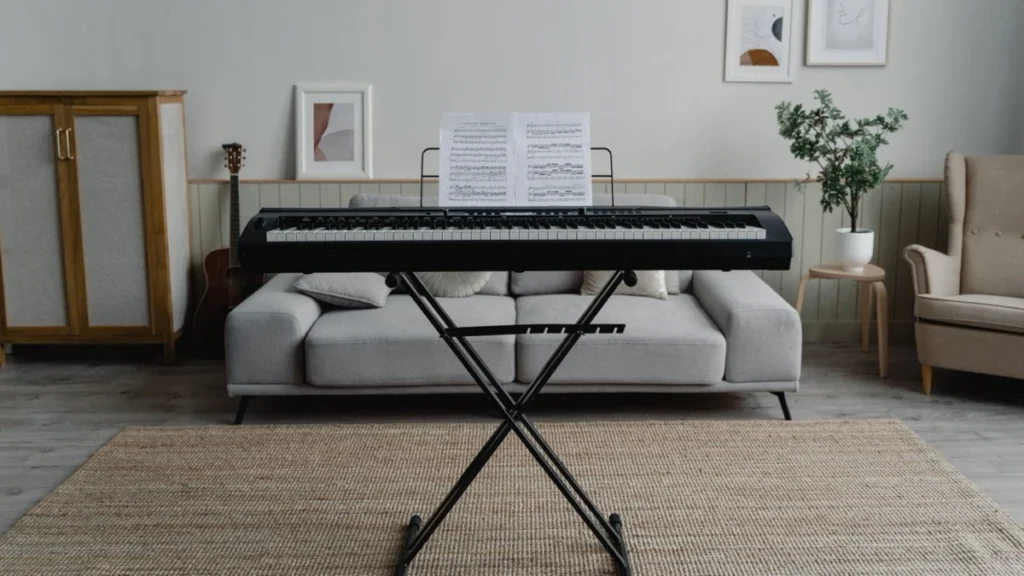
Answer First: Portable or Console for an Apartment?
Choose a portable/slab digital piano if you expect to move, need flexible placement, or want to build the stand and pedal setup in stages. Choose a console digital piano if the instrument will stay in one place and you value an integrated stand, pedals, speakers, and cleaner cable management. For an apartment, compare the complete assembled footprint and practice routine—not the keyboard body alone. Neither form guarantees better keys, sound, or learning value; those are model-specific.
Best For—and Not For
Best for
- Beginners buying a first piano-style instrument for lessons or self-guided practice.
- Renters and apartment households planning quiet headphone sessions.
- Near-purchase buyers comparing space, key feel, pedals, furniture fit, and moving effort.
- Players who want 88-key piano practice rather than beatmaking controls.
Not for
- Current model rankings, live deals, or unsupported “best sound” claims.
- Stage performers who need detailed gigging, amplification, and road-case advice.
- Producers whose main needs are pads, knobs, DAW mapping, and software instruments.
- Acoustic-piano buyers who need tuning, humidity, structural-load, or professional moving guidance.
Quick Decision Table
| Apartment decision | Portable/slab digital piano | Console digital piano |
|---|---|---|
| Best reason to choose it | Flexible placement and easier moving | Permanent, stable, integrated practice station |
| Apartment fit | Good when the setup may move or change | Good when one corner can remain dedicated |
| Stand and pedals | Often separate; compatibility and stability must be checked | Usually integrated cabinet and three-pedal unit |
| Bench | Usually a separate decision | May be bundled in some regions, but never assume |
| Moving | Can usually be separated from stand/pedals | Heavier and more awkward; may require disassembly and help |
| Headphone practice | Common, but check jack type, placement, and speaker-muting behavior | Common, sometimes with two headphone jacks; verify the model |
| Speaker priority | Often secondary to portability and headphones | Often a stronger part of the furniture-style home experience |
| Key action | Ranges from basic to advanced; category label does not decide quality | Ranges from basic to advanced; cabinet alone does not decide quality |
| Main hidden cost | Stand, pedals, bench, headphones, and storage | Delivery, assembly, moving effort, and permanent floor space |
| Main limitation | A poor stand or loose pedal can undermine daily practice | Harder to relocate if the room or lease changes |
Choose a Portable Digital Piano When the Room May Change
A portable digital piano usually places the keyboard, controls, speakers, and connections in a slab-style case. It can sit on a folding stand or a compatible furniture stand. Yamaha’s P-series and Roland’s FP line illustrate the category: both offer weighted 88-key models with built-in speakers and headphone support, while compatible stands and upgraded pedals may be separate accessories.
The important word is separable, not weightless. A current Yamaha P-225 specification, for example, lists the piano itself at 25 lb 6 oz before adding a stand, pedals, bench, headphones, and power accessories. Use manufacturer dimensions for the model you are considering; never assume that “portable” means it can live safely on a desk, bed, or narrow shelf.
It is the best fit when:
- You rent or expect to move within the life of the instrument.
- The room may switch between office, guest-room, or practice uses.
- You want to choose between a folding stand now and a matching furniture stand later.
- You may take the piano to lessons, rehearsals, or another home.
- You want to control the total setup one component at a time.
Skip it when:
- You know the piano will stay permanently in one room and you want an integrated look from day one.
- You do not want to research stand, bench, pedal, and accessory compatibility.
- A folding stand would be bumped by children, pets, or a busy walkway.
- You need a stable three-pedal arrangement immediately and the model’s compatible unit is unavailable.
Complete portable-piano setup
- 88-key weighted digital piano if piano lessons and acoustic-piano technique are the goal.
- A manufacturer-approved or demonstrably compatible stand rated for the instrument’s size and weight.
- An adjustable bench that places the elbows near keyboard height and supports stable posture.
- Sustain pedal or compatible three-pedal unit; verify polarity, connector, half-pedal support, and stand requirements.
- Specified power adapter and safe cable route.
- Wired headphones with the correct plug or adapter.
- Music rest if it is not built in.
- Optional dust cover and carrying case if the piano will actually move.
- A vibration-damping solution that does not make the stand unstable if floor transmission is a problem.
Choose a Console Digital Piano for a Permanent Practice Corner
A console digital piano combines the keyboard with a furniture-style cabinet, integrated stand, and usually a fixed three-pedal unit. Yamaha defines its ARIUS line as a classic console digital piano series and documents weighted actions, three pedals, and headphone jacks across current models. That integrated structure is the main apartment advantage: the pedals stay in place, the keyboard sits at a consistent height, and cables can be managed as part of one installation.
The tradeoff is commitment. A console takes permanent floor and bench space and is more difficult to move through doors, stairs, or a lease change. It may arrive in multiple heavy sections that require assembly. Included accessories can vary by country or retailer, so “console” does not guarantee that a bench, headphones, delivery, or assembly is included.
It is the best fit when:
- You have measured one dedicated corner and expect the piano to stay there.
- You value a stable three-pedal unit and a consistent playing position.
- The instrument should look like permanent furniture in a living room.
- You want the setup to remain ready without folding, storing, or reconnecting parts.
- Two headphone jacks or teacher-student use matter and the exact model supports them.
Skip it when:
- You expect to move frequently or carry the instrument up stairs.
- The room layout is likely to change.
- You cannot leave enough bench and walking clearance in front of the cabinet.
- You are choosing the cabinet mainly because you assume its key action is better than every portable model.
Complete console-piano setup
- Console digital piano with all cabinet, pedal, fastener, and power components confirmed.
- Correct bench; confirm whether it is included in your region and whether its height works for the player.
- Wired headphones and the correct connector or adapter.
- Delivery path measurements: box dimensions, doors, corners, elevators, and stairs.
- Safe assembly plan with the number of people required by the manufacturer.
- Stable, level floor position with power and headphone cables away from walking paths.
- Optional vibration-damping mat or isolators that do not compromise stability.
- A realistic plan for disassembly or professional help at the next move.
For Learning Piano, Compare the Action Before the Cabinet
Yamaha’s keyboard-selection guide identifies key responsiveness, number of keys, and ergonomics as major digital-piano buying considerations, and notes that weighted keybeds provide a more realistic piano feel when transitioning from acoustic piano. That supports a practical beginner rule: if the goal is conventional piano lessons, compare 88-key weighted actions in person before spending extra on cabinet style or speaker power.
Do not convert that rule into “heavier is always better.” Actions differ in repetition, return, texture, pivot feel, and how tiring they feel to an individual player. A teacher may also have a minimum requirement for lessons. A portable and a console can use closely related action technology, so the exterior category does not settle the question.
Use this five-minute action check
- Play repeated notes softly and then firmly across low, middle, and high registers.
- Check whether quiet notes respond without excessive force.
- Play a simple five-finger pattern and notice whether the keys return predictably.
- Try the sustain pedal and confirm it stays in place.
- Ask whether the action still feels manageable after several minutes, not just impressive on the first chord.
This is a fit check, not a laboratory test. If you cannot try the instrument, prioritize a clear return policy and compare the exact action name—not just “weighted keys.”
Headphones Reduce Speaker Noise, but They Do Not Make Practice Silent
Both portable and console digital pianos commonly support headphone practice. The exact number, size, and placement of headphone jacks vary, and some models may require a 3.5 mm-to-6.35 mm adapter. Verify whether connecting headphones automatically mutes the built-in speakers and whether two listeners can connect at once.
Headphones remove the amplified piano sound from the room, but weighted key mechanisms and pedals still create physical sound and vibration. Roland’s support guidance states that hammer-action keyboards can produce mechanical clacking and pedal operation can transmit noise or vibration; these sounds cannot be removed through a piano setting. The company recommends stable soundproofing or vibration-damping materials when needed and warns that mats or isolators must not compromise instrument stability.
Apartment noise checklist
- Test the keys and pedal with the piano volume at zero; listen from the next room if possible.
- Ask downstairs or adjacent household members which times are most sensitive.
- Keep the stand or cabinet stable; wobble can add impact noise.
- Do not place pedals directly against a shared wall or loose baseboard.
- Use a mat only if it supports the entire setup safely.
- Keep headphone volume moderate and take breaks. Quiet to the room can still be loud at your ears.
Measure the Whole Practice Zone, Not Just the Piano
Product dimensions usually describe the instrument or cabinet, not the human space required to sit, pedal, stand up, and walk past. Yamaha’s posture guidance says the bench should be centered, the player should sit toward the front half, and bench height should place the elbows approximately level with the keyboard. That means bench depth and pull-back space are part of the buying decision.
Record these measurements before shopping
- Piano width and depth, including music rest if it remains installed.
- Stand or cabinet depth at floor level—not only the keyboard case depth.
- Bench width, depth, and space needed to pull it back.
- Comfortable leg and pedal clearance.
- Distance to the power outlet and headphone-cable path.
- Door, closet, radiator, window, and walking-path clearance.
- Box and stair/elevator clearances for delivery and the next move.
A slab on a deep folding stand can occupy as much usable floor depth as a slim console. Compare the assembled footprint, not product photography.
Choose by Your Apartment Scenario
“I rent and may move next year.”
Choose a portable 88-key model, then add a stable stand and pedal that can move separately. Keep the original packaging only if you have dry, safe storage for it.
“The piano will stay in one living-room corner.”
A console is easier to justify. Measure the cabinet, bench, and walking path, and confirm delivery and assembly before ordering.
“I practice almost entirely with headphones.”
Do not pay primarily for speaker power. Compare action, headphone connection, volume control, comfort, mechanical noise, and whether the setup remains stable.
“I need to put the piano away after every session.”
A portable is usually the more practical category of the two, but an 88-key weighted piano is still substantial. Confirm a safe storage orientation and lifting route in the owner’s manual. If daily teardown is unrealistic, reconsider the room plan rather than balancing the piano on temporary furniture.
“My child is starting lessons.”
Ask the teacher about required key count, weighted action, and pedal needs. Choose the most stable setup you can fit; a fixed console is not mandatory, but a weak stand and sliding pedal are avoidable obstacles.
Limitations and Tradeoffs
- Portable does not mean small in every dimension. Full-size 88-key instruments remain wide, and stand plus bench clearance controls the real footprint.
- Console does not guarantee a superior action. Compare the exact mechanism and player fit.
- Headphones do not eliminate mechanical noise. Key and pedal impact can still travel through floors and walls.
- Accessory bundles vary. Benches, headphones, power adapters, stands, and pedal units can be included, optional, or region-dependent.
- Bluetooth audio is not automatically Bluetooth headphone output. Check the manual for signal direction and supported use. Wired headphones are the predictable apartment-practice path.
- Furniture finishes are not room measurements. Marketing images rarely show bench pull-back or traffic flow.
- Moving can damage an instrument. Follow the manufacturer’s disassembly, orientation, and lifting instructions.
Alternatives to Consider
- Portable piano with matching furniture stand and three-pedal unit: the middle path when you want an integrated look now but may separate the parts later.
- Slim console: a useful variation if permanent setup matters but cabinet depth is the main constraint; measure pedal base and anti-tip hardware too.
- MIDI controller: better if production controls and software instruments are the goal, but it requires a computer/device and is not automatically a substitute for an 88-key weighted piano-practice setup.
- Fewer-key portable keyboard: easier to store, but may conflict with two-handed repertoire or a teacher’s requirements. Treat it as a different learning compromise, not simply a smaller digital piano.
- Used digital piano: can expand your options, but test every key, pedal, headphone output, speaker, control, power supply, and included stand before buying. Confirm that replacement parts and manuals still exist.
Buy-Before Checklist
- Confirm the goal: piano lessons/practice, production, or casual keyboard use.
- Ask the teacher whether 88 weighted keys and a particular pedal capability are required.
- Measure instrument, stand/cabinet, bench pull-back, legs, pedals, and walking clearance.
- Try the exact key action, or buy with a realistic return window.
- Check headphone jack count, size, location, volume control, and speaker-muting behavior.
- Listen to the physical key and pedal noise with electronic volume at zero.
- Verify every included item by region: stand, pedal, bench, power adapter, music rest, and headphones.
- For a portable, confirm stand load rating, mounting method, pedal compatibility, and anti-slip stability.
- For a console, measure delivery boxes, doors, elevator/stairs, and assembly space.
- Check whether USB is MIDI-only or carries audio if computer recording matters.
- Do not assume Bluetooth sends piano sound to wireless headphones.
- Plan the next move before buying a cabinet you cannot safely carry.
Frequently Asked Questions
Is a console digital piano better for beginners?
Not automatically. A console gives you an integrated stand and pedals, which can make the practice station more stable and consistent. A portable model with an appropriate stand and pedal can support the same beginner routine. Compare the exact action, ergonomics, and setup.
Is a portable digital piano easier to move?
Usually, because the keyboard can be separated from the stand and pedal system. It can still be wide and heavy enough to require two people. Follow the model’s lifting and storage instructions.
Do I need 88 weighted keys to learn piano?
They are the most direct path for conventional piano lessons and full-range repertoire, but your teacher and goals should decide the requirement. Weighted actions also vary; “88 weighted keys” is a starting filter, not a quality verdict.
Can neighbors hear a digital piano when I use headphones?
They will not hear the amplified piano sound from its speakers, but they may hear key action, pedals, bench movement, or vibration through the floor or wall. Test the mechanical noise separately and use stable damping materials if needed.
Should I prioritize key action or speakers in an apartment?
If headphones will be your normal practice method, key action, headphone experience, and stable posture deserve priority over maximum speaker output. Speakers still matter for daytime playing, lessons, and sharing music.
Does a portable digital piano include a stand and pedal?
Sometimes, but not reliably. Many slab models include a basic sustain switch while matching stands, three-pedal units, benches, and headphones are separate. Check the official “included accessories” and “optional accessories” lists for your region.
Does a console digital piano include a bench?
It depends on model, country, and seller package. Official specifications may state that the bench varies by area. Confirm the exact package in writing before buying.
Can I use Bluetooth headphones with a digital piano?
Only if the manufacturer explicitly supports Bluetooth headphone output. Bluetooth audio on a piano often means receiving music from a phone, not transmitting live piano sound. Wired headphones avoid that ambiguity and potential latency.
Can a portable piano become a furniture-style setup later?
Yes, when the manufacturer offers a compatible matching stand and pedal unit. Confirm compatibility before choosing the piano; accessory availability can change.
Which type uses less apartment space?
Neither category always wins. A slab case may be shallow, but its stand and bench can expand the floor footprint. A slim console may be deeper as an instrument but manage pedals and cables more neatly. Compare assembled measurements and the sitting zone.
Evidence and Recommendation Boundary
This is a category comparison. Named manufacturer pages illustrate documented differences in construction, accessories, key action, headphone support, pedals, dimensions, and mechanical-noise considerations. They are not rankings or endorsements, and one model’s feature does not apply to every portable or console piano.
MusicalCritic has not claimed hands-on testing, lab measurement, current pricing, stock, ratings, sales volume, brand authorization, or a universal winner. Before publication, the editor should re-open each official source, verify that the referenced models and accessories remain current, and confirm any package contents for the reader’s region.
Sources
| Source | What it verifies | Boundary |
|---|---|---|
| Yamaha: Guide to Choosing a Keyboard | Console versus portable/stage exterior distinction; importance of responsiveness, key count, ergonomics, and weighted action. | General manufacturer guide; model availability and naming evolve. |
| Yamaha: Portable Digital Pianos | Representative portable category with compact designs, weighted actions, speakers, and headphone-oriented features. | Yamaha category page, not a claim about all brands or every P-series model. |
| Yamaha: P-225 Specifications | Example of portable-piano dimensions, weight, headphone outputs, included items, and separately sold stand/pedal/headphones. | One current example; package contents and accessories may vary by region. |
| Yamaha: ARIUS Console Digital Pianos | Representative console category with cabinet, weighted keys, three pedals, and headphone connections. | One manufacturer’s console line; exact model features vary. |
| Roland: How to Reduce Digital-Piano Noise/Vibration | Hammer-action and pedal mechanisms can create physical noise/vibration even when electronic sound is quiet; stable damping guidance. | Manufacturer support guidance; building construction and transmission differ. |
| Roland: FP-10 Owner’s Manual | Representative portable setup requirements: approved stand placement, stability warning, headphones, pedal, and power connections. | One model’s safety instructions; follow the manual for the exact piano purchased. |
| Yamaha: Correct Piano Posture | Bench centering, seating position, and bench height relative to elbows. | General posture guidance; individual needs may require teacher or clinician input. |
| World Health Organization: Safe Listening | Listening risk depends on level, duration, and frequency; lower volume and breaks reduce risk. | Health guidance, not a measurement of any piano or headphone. |
Suggested Internal Links
- Best Digital Pianos for Beginners
- MIDI Keyboard vs Digital Piano for Beginners
- How Weighted Keys Affect Digital Piano Practice
- How to Connect a Digital Piano to a Computer
- Yamaha P-145BT vs Yamaha P-225
- Yamaha P-145BT vs Roland FP-10
- Is Yamaha P-145BT Good for Apartments?
- Can You Practice Digital Piano With Headphones?
- Do Digital Pianos Need External Speakers?
- Digital Pianos Hub
- Editorial Policy
- Affiliate Disclosure
How We Test
Editorial research and first-party documentation; no hands-on or lab testing is claimed.
Review Basis
First-party manufacturer documentation, authoritative safe-listening guidance, and apartment-fit editorial analysis.